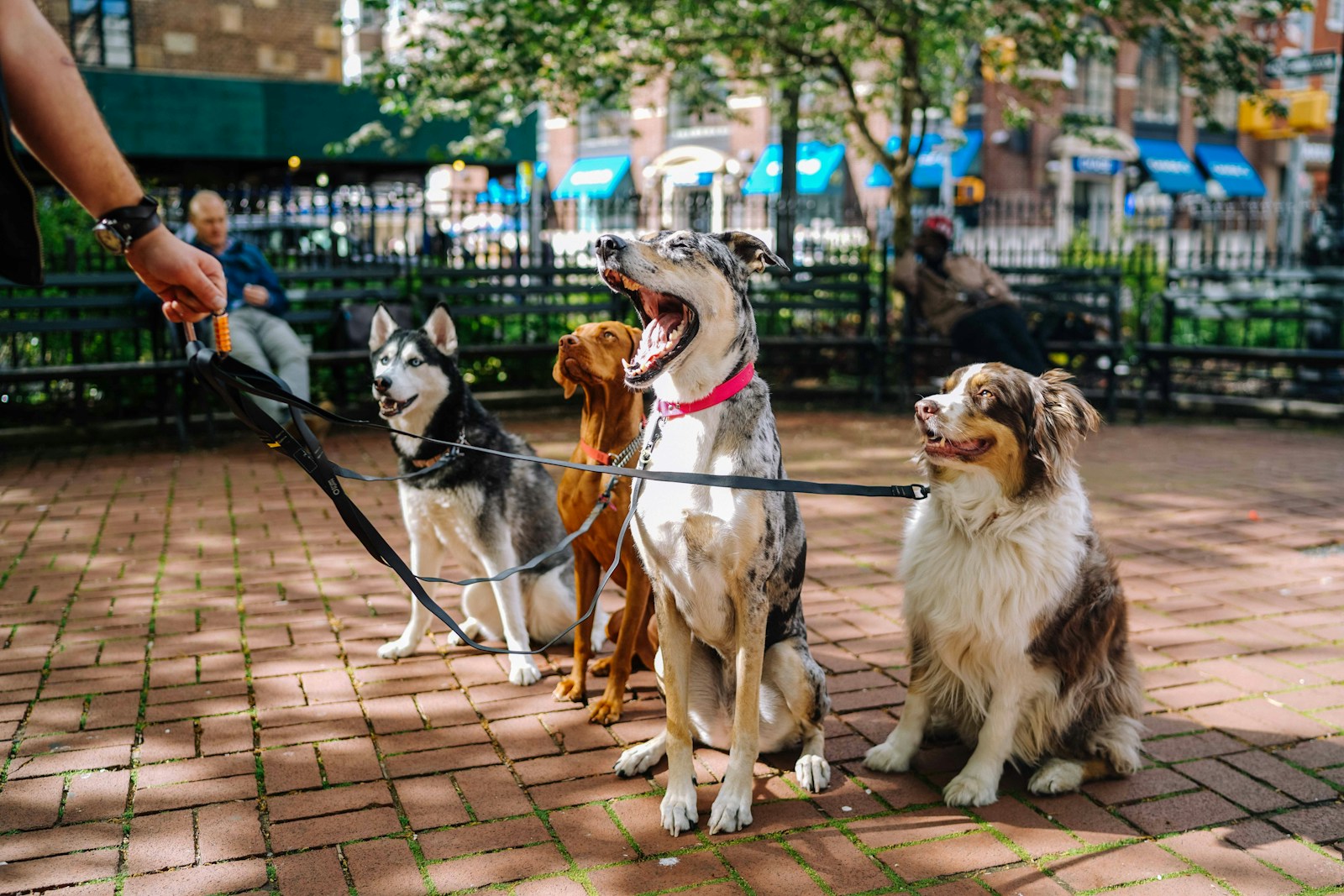
If your dog drags you down the street, you are not doing anything wrong as an owner — you are up against basic dog physics. Dogs walk at roughly twice our pace, and when a dog pulls and the walk continues anyway, the pulling gets rewarded. Every single time. Most dogs have had that lesson reinforced hundreds of times before anyone tries to fix it.
The good news is that leash pulling is one of the most fixable dog behaviours there is. It does not require a specialist, a shock collar, or months of work. It requires understanding one rule and applying it consistently for about two weeks.
Why dogs pull on the leash
There are three reasons, and they stack:
- Pulling works. The dog pulls toward a smell, you follow, the dog reaches the smell. From the dog's point of view, pulling is a reliable technique for getting places.
- The opposition reflex. Dogs — like people — instinctively push back against steady pressure. When you brace against a pulling dog, you are physically triggering the dog to pull harder. This is why a tug-of-war on the leash never resolves.
- Walks are overstimulating. For a dog that gets one walk a day, that walk is the entire day's worth of novelty compressed into thirty minutes. Excitement expresses itself as forward pressure.
Notice that none of these are dominance, stubbornness, or a bad dog. They are all mechanical. That matters, because it means the fix is mechanical too.
The one rule: a tight leash means the walk stops
This is the whole method. When the leash goes tight, you stop moving. Not a correction, not a yank — you simply become a tree. The moment the leash softens, even slightly, you walk again.
What you are teaching is a single clean association: loose leash makes the world move, tight leash makes the world freeze. Dogs work this out startlingly fast when the rule is applied without exceptions.
Two things make or break it:
- Consistency beats intensity. One walk where you let the pulling slide teaches the dog the rule is negotiable, and negotiable rules get tested forever.
- Your timing has to be immediate. Stop the instant the leash tightens, restart the instant it loosens. A two-second delay and the dog cannot tell what you are responding to.
The seven-step routine
- Start indoors or in the yard. A hallway with no squirrels is a fair place to introduce a new rule. The street is an exam, not a lesson.
- Pick your side and stay on it. Left or right does not matter; switching does. A consistent side gives the dog a position to find.
- Hold the leash with slack in it. If you walk with a permanently taut leash, there is no "loose" state for the dog to discover.
- Stop dead the moment it tightens. Say nothing. Do not pull back. Just stop.
- Wait for slack. The dog will eventually look back, step back, or sit. The instant the line softens, say "yes" and walk on.
- Reward the position, not just the absence of pulling. When the dog is walking near your leg on a loose line, that is the behaviour you want to see more of — mark it and treat it. Punishing pulling teaches what not to do; rewarding position teaches what to do instead.
- Add distraction slowly. Quiet street, then busier street, then the park. If the dog fails at a level, you moved up too fast — go back one.
Expect ten to fifteen minutes of extremely slow walking for the first few sessions. This is normal and it is the actual work. By day four or five most dogs have connected the dots, and by two weeks a loose leash is the default.
Where the gear comes in
No piece of equipment trains a dog. What good gear does is remove the friction that makes people quit the training halfway through.
The single biggest hardware factor is leash control. A leash that jams, or that has no way to shorten it quickly, forces you into exactly the bracing tug-of-war that triggers the opposition reflex. A retractable leash with a genuine one-touch lock lets you give a well-behaved dog room to sniff and then shorten the line instantly when a distraction appears — and locking the line short is a very different action from hauling on it.
Gear that helps: the LED Flashlight Retractable Dog Leash has a lock button and a quick-release brake, in 3M and 5M lengths. Being able to fix the length in one thumb press is what makes the stop-and-go method practical on a real street — and its light ring and flashlight mean the same leash covers the dark evening sessions too.
Make sure a lunge can't cost you the leash
Early in training, before the new rule has sunk in, a dog that spots a cat or a squirrel will still hit the end of the line hard. That is the moment the handle leaves most people's hand — and a dog that gets free once has learned that a big enough lunge ends the walk on its terms.
The fix is a strap that ties the handle to your wrist, so a lunge you were not braced for costs you a step, not the dog. It matters most with a retractable leash, whose chunky handle is exactly the thing that jolts loose.
Gear that helps: the Anti-Drop Leash Wrist Strap clips onto any leash, retractable or standard, and tightens around your wrist. If the handle slips, it stays with you instead of skittering down the pavement behind a running dog.
Free your hands
The second friction point is more mundane: you cannot train a dog while juggling. Loose-leash work needs one hand on the leash and one hand free for treats and for marking good position. If one hand is permanently occupied by a bag of waste, the training simply does not happen.
This is worth solving properly. A hands-free poop bag clip takes the used bag off your hand and onto the leash, and an anti-drop wrist strap helps too: with the handle secured to your wrist, you can loosen your grip to reach for a treat without any risk of dropping the leash. Small things — but they are the difference between doing the routine and skipping it.
What not to do
- Do not yank the leash. It triggers the opposition reflex, it can hurt the dog's neck and trachea, and it teaches nothing because the dog cannot tell what the yank refers to.
- Do not switch methods every few days. Most "this doesn't work" reports are actually three different methods applied for four days each.
- Do not train on the walk your dog has waited all day for. A dog at peak excitement cannot learn. Take the edge off with five minutes in the yard first.
- Do not expect a straight line of progress. Dogs regress after a good week. That is normal learning, not failure.
How long it should take
For a young dog with a consistent handler: noticeable improvement in three to five days, a reliable loose leash in two to three weeks. For an older dog with years of successful pulling behind it, double that. The variable is almost never the dog — it is how consistently the rule gets applied by every person who walks it.
Get everyone in the household on the same rule before you start. One family member who lets the dog pull will hold the whole process back indefinitely.



 Welcome To The Pack